

Roderick Mead
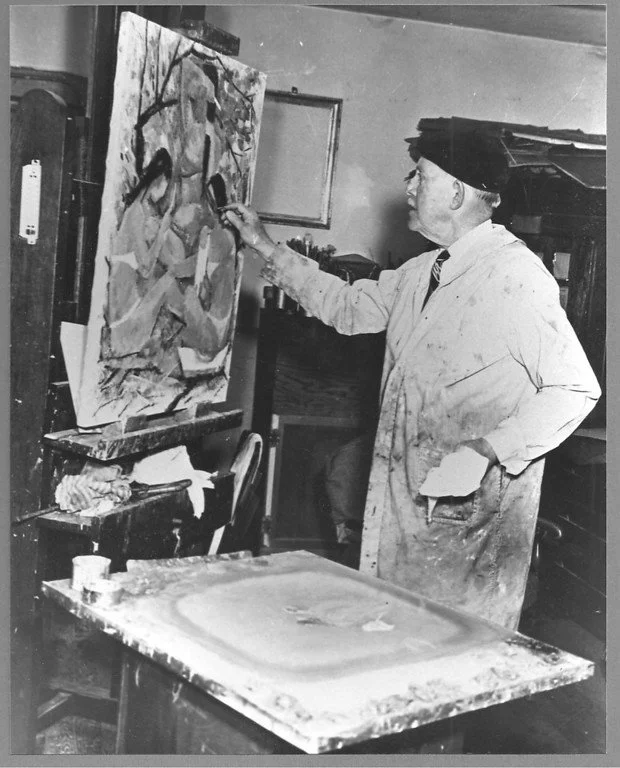
As an artist, Roderick Fletcher Mead sought new rhythms and forms through multiple artistic mediums. Mead was born June 25, 1900, in South Orange, New Jersey. He attended the Newark Academy and later Yale University, where he received a degree in fine arts in 1925. Mead then moved to New York to study at the Art Students League. His principal teacher was the noted painter George Luks, with whom he later studied privately. From 1927 to 1929, he attended the Grand Central School of Art, where he studied watercolor technique from George Pearse Ennis, then considered the leading watercolor teacher in New York.
In 1931, Mead moved to the Spanish Island of Mallorca. In 1934, he relocated his studio to Paris, where he married Jarvis Kerr, whom he had met on the island of Mallorca. Mead soon began studying printmaking under Stanley William Hayter at the experimental Atelier 17 studio. The influence of Hayter and the other artists at Atelier 17 on Mead cannot be overstated. Other artists working at Atelier 17 during that period included Joan Miró, Pablo Picasso, Alberto Giacometti, Max Ernst, Yves Tanguy, Jean Hélion, John Buckland Wright, and Wassily Kandinsky. Mead began to experiment with abstraction and surrealism at this time. To benefit victims of the Spanish Civil War, Hayter asked Mead, Miro, Kandinsky, and others to contribute a print to a portfolio of Stephen Spender's poem Fraternité (March 1939).
The Meads returned to the United States prior to World War II. They briefly lived on Long Island, New York, and in Maine before settling in Sarasota, Florida, and then in Carlsbad, at the home of Jarvis's father, Howard Kerr, in 1941.
During World War II, as part of the war effort, Mead was employed in the drafting office of the Potash Company of America (1942-44). He created the company’s “The Salt of the Earth” emblem and designed ore-refining machines. Mead set up a studio in Carlsbad, where he also taught painting classes. After the war, Mead was able to devote himself to creating art full-time. He exhibited regularly in the Southwest, New York, and California. Following the sudden death of his son in May 1950, Mead became despondent and worked very little. By 1953, he resumed painting and printmaking, but rarely exhibited his work outside of New Mexico.
The Meads resumed their travels and spent summers in Europe, returning to Carlsbad for the beginning of the school year. In the late 1950s, Mead began his best-known print series, The Zodiac. The prints in this series fused science and myth, surrealism and nature. The constellations are depicted on the picture plane, with the symbols they represent shown in either abstract biomorphic forms or with scientific precision. The period from the 1950s into the late 1960s was one of great activity as Mead created a large number of prints and large-scale canvases. In 1968, Mead created nine wood engravings to illustrate Brandings, a collection of poems by Katherine Arnstein Heinemann (Cummington Press).
Roderick F. Mead survived a bout with cancer in the late 1960s and returned to work, maintaining a regular working schedule. A second cancer diagnosis in 1970 proved to be more serious. Mead continued to create art until days before his death on May 5, 1971.